“Ne’er cast a clout till May be out” – an old country saying for the season of spring.
And waking this morning to a mist so heavy that I can’t see this side of the valley, never mind the far side, I was reminded of it. My early morning wander around the garden with the first cup of coffee, dog and cats for company required an extra layer.
But back to our proverb. The origins of the saying are interesting, but let’s break the saying into two parts to explore its meanings and origin more fully.
Ne’er cast a clout till May be out
Taking the first part of the saying, what does ‘clout’ mean? It’s a word which has been in usage since at least the early fifteenth century, and has been variously spelt as clowt, clowte, cloot, clute.
But what does ‘clout’ mean? The meaning we’re probably most familiar with nowadays is ‘a blow to the head’. But the word has meant – and to a certain degree still does mean ‘a clod of earth’, ‘ a lump or dollop of clotted cream’, ‘a fragment of cloth’ and ‘an item of clothing’. This last being clothing which one would throw on quickly such as a shawl, scarf or small cloak.
It is worth pointing out that shawls and scarves, whether knitted, a woven piece of cloth such as tartan, cotton or fine silk, were worn commonly by both men and women until the modern advent of centrally heated houses. According to the Oxford English Dictionary the term ‘scarf’ first appears in documents in the mid sixteenth century. But this doesn’t mean that this piece of clothing wasn’t around before then, as it was referring to a commonly used item.
And it is as an extra layer for warmth, ‘an item of clothing’ that the saying Ne’er cast a clout till May be out may well be referring to. It is a reminder not to be too quick to shuck off the winter woollies before the chilly days of May are over.
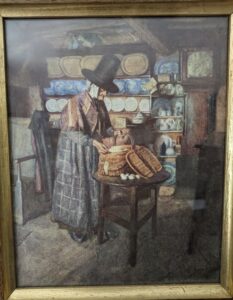
watercolour, ‘Market Day ‘ by Sydney Curnow Vosper, 1910, Welsh woman in her cottage. photo of our print of the original

Ne’er cast a clout till May be out
The second meaning for the word ‘May’ used in the saying could represent ‘the May’, which is a term used for Hawthorn blossom.
Hawthorn, Crateagus monogyna is a British native. A small (ish) tree that you can find both growing as an individual specimen and forming a major part of hedgerows. It is the only British tree or shrub which is named for the month in which it blooms. And you certainly can’t miss it as it attracts bees in their hundreds to its pollen rich flowers.

The name ‘Haw’ derives from ‘hage’, which is the Old English spelling for ‘hedge’. Haw is also the name for the berries of the hawthorn.
Found throughout the British Isles with white blossom, there is also the Midland Hawthorn, Crateagus laevigata, which has pale pink blossom. And various cultivars including a dark pink flowered form of the Midland hawthorn, Crateagus laevigata ‘Paul’s Scarlet’ and an upright rather than spreading tree, Crateagus monogyna ‘Stricta’.
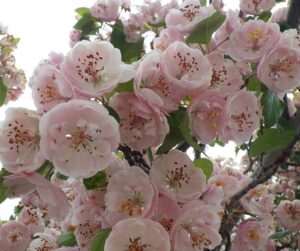
But back to the country saying. Perhaps ‘Ne’er cast a clout till May be out’ could mean keep your shawl or coat on until the hawthorn is fully blooming. At certain periods over the last couple of millennia we have records of both much a warmer climate and of mini ice ages. Using the time of year at which the May tree blossomed was a simple method of working out (approximately) how likely an overnight frost would be.
When you consider that the Hawthorn of course blooms earlier in southeast England than it does in northeast Scotland it begins to look like this interpretation could be the right one. We further need to remember that the populace was largely rural-based and illiterate. They wouldn’t expect there to be no frosts until all the hawthorn in their area, ie including the cooler, shadier spots was blooming.
and finally
Whichever origin you prefer for the saying ‘Ne’er cast a clout till May be out’, it has its uses. Not least for reminding gardeners in most of the country to be alert for potential frosts overnight even when they’re working in the garden without wearing a thick jacket…

